Liberal Democrats in Sutton back greater democracy in first major council meeting since 2026 election
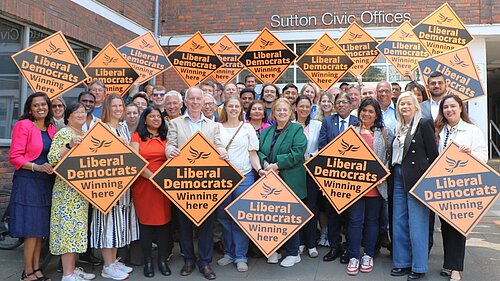
Several new Liberal Democrat Councillors made their maiden speeches as Sutton Council approved motions on “Fair Votes for All” and “Delivering for Sutton’s Neighbourhoods” at Monday night’s meeting. One concerned how votes are translated into seats. The other addressed how councillors and residents can continue to influence decisions once those seats have been won.
The Fair Votes for All motion called for proportional representation in UK general elections and English local elections. It also asked Sutton’s political group leaders to write collectively to the new Prime Minister, calling for a National Commission on Electoral Reform to report before the next general election.
The motion openly recognised that the current First Past the Post system benefited the Liberal Democrats in Sutton in May. The party received 44 per cent of votes across the borough and won 51 of the Council’s 55 seats. Reform UK won two seats, Labour one and an Independent one, while the Conservatives and Greens were left without councillors despite receiving 17 per cent and 11 per cent of the vote respectively.
Proposing the motion, re-elected Carshalton South and Clockhouse councillor Lisa Webster said the party should apply its democratic principles consistently, including when the current system worked in its favour.
“True principle means advocating for fairness even when it goes against your own short-term advantage,” she said.
“Every resident who went to a polling station in Sutton did so because they care about their community. Whether they voted Liberal Democrat, Reform, Conservative, Green, Labour, or Independent, they deserve to hear their voice articulated in the room where decisions are made.”
Re-elected Sutton South councillor Richard Clifton drew on his experience of working with councillors in Amsterdam, where proportional representation regularly requires different parties to cooperate. He said PR encouraged “shared understandings and shared solutions” and could support “a gentler and less confrontational form of politics”.
The second motion focused on democratic participation inside Sutton itself. Proposed by Councillor Jake Short and seconded by Councillor Jayne McCoy, it committed the Council to embedding greater citizen engagement in its new Corporate Plan and protecting the ability of ward councillors to influence policy.
That commitment comes as Sutton is required to replace its committee system with a nationally imposed “strong executive model”. Under the current system, councillors from across the political parties take part directly in policy committees. The replacement model will place executive decisions in the hands of a smaller group of councillors.
Re-elected Wallington South councillor Jayne McCoy, who has served on the Council since 2006 and has worked under both systems, told the meeting that the committee model allowed more councillors to shape decisions before they were taken.
“Challenge makes for better decisions. Transparency means accountability. And wider participation means a variety of voices and representatives are heard,” she said.
Councillor McCoy said Sutton would make the new arrangements work while maintaining cross-party discussion, public scrutiny and the borough’s Local Committees, where residents can question councillors and help decide local priorities.
The debate also gave several councillors elected in May the opportunity to make their maiden speeches, with each grounding the discussion about democracy in practical neighbourhood work.
Newly elected Cheam councillor Melody Thorpe said in her maiden speech that Local Committees should be places “where local priorities are heard, where communities help shape decisions, and where communication between the Council and our neighbourhoods is strengthened”.
In his maiden speech, newly elected Hackbridge councillor Tom Foster said: “A strong executive model must not trade off the power of local councillors to influence decisions.” He pointed to local casework, fly-tipping reports and community groups as examples of how councillors can ensure residents’ voices reach the Civic Offices.
Newly elected Worcester Park South councillor Dr Jenna Hartley-Smith used her maiden speech to highlight work with residents around Cuddington Recreation Ground. “I stood because I believe government works best when it listens first,” she said.
Following the 2026 election, every part of Sutton now has at least one Liberal Democrat councillor for the first time. The two motions set out how the council intends to use that mandate: by keeping local decision-making open to residents and councillors, while making the case for an electoral system that represents voters more fairly.
As Councillor Thorpe told the chamber in her maiden speech, decisions should remain “rooted in our neighbourhoods and shaped by the people who live in them”.